
Japanese kitchen knives come with their own vocabulary — steels, constructions, finishes, blade shapes and parts. This glossary explains the terms you'll run into when shopping for, using or sharpening a Japanese knife, with the original Japanese where it helps.
Steel and Materials

The steel decides how sharp a knife gets, how long it stays sharp and how much care it needs. Our steel comparison chart puts the common ones side by side.
- Hagane (鋼) — Steel; in knife making, the hard high-carbon steel that forms the cutting edge.
- Jigane (地金) — The soft iron or soft steel forge-welded around or beside the hagane. It absorbs shock and makes the blade quicker to sharpen.
- Shirogami (White Steel) (白紙鋼) — "White paper steel," named for the color of the label its maker used. A very pure high-carbon steel that takes the keenest edge and is the easiest to sharpen. Like all carbon steel, wipe it dry after use. Sold as #1 (more carbon, harder), #2 (the most common) and #3 (softest and quickest to sharpen).
- Aogami (Blue Steel) (青紙鋼) — "Blue paper steel": White Steel with chromium and tungsten added, so it holds an edge longer and resists wear better. Sold as #1, #2 and Super.
- Aogami Super (Super Blue) (青紙スーパー) — The most highly alloyed Blue Steel, with molybdenum and vanadium as well. The longest edge life of the traditional carbon steels, and a little slower to sharpen.
- Ginsan (Silver #3) (銀三鋼) — A fine-grained stainless steel that sharpens almost like carbon steel. A popular choice for low-maintenance single-bevel knives.
- VG-10 — A stainless steel with cobalt and vanadium, known for good edge retention and rust resistance. One of the most common core steels in Japanese damascus knives.
- AUS-8 / AUS-10 — Stainless steels often sold as INOX. AUS-8 is softer and very easy to sharpen; AUS-10 has more carbon and holds an edge longer.
- SG2 / R2 — A powdered stainless steel sold under two names. Very hard and fine-grained, with long edge life and good rust resistance.
- ZDP-189 — A powder steel with very high carbon and chromium, hardened to around HRC 66–67. Outstanding edge life, slow to sharpen, and semi-stainless rather than fully stainless.
- HAP-40 — A powdered high-speed tool steel. Extremely hard and wear-resistant, but low in chromium, so it should be dried promptly.
- SRS13 — Another powdered high-speed steel, prized for long edge life under heavy use.
- SLD — A semi-stainless tool steel first made for industrial cutting dies. Long edge life with far less rust risk than carbon steel.
- Powder steel (粉末鋼) — Steel made by pressing very fine metal powder together under heat and pressure, rather than casting it. The result is a very even, fine grain that can carry more alloy and higher hardness without becoming brittle.
- Semi-stainless — Steel with some chromium, but not enough to be fully stainless. It resists rust better than carbon steel but can still stain if left wet.
- HRC (Rockwell hardness) — The scale used to measure steel hardness. Most Japanese knives fall between about HRC 60 and 67, harder than the 54–58 typical of German knives.
Browse knives by steel: White · Blue · VG-10 · Ginsan · SG2/R2 · ZDP-189 · HAP-40
Construction
How the steel is put together matters as much as which steel is used.
- Honyaki (本焼) — A blade forged from one piece of high-carbon steel and hardened with a layer of clay, so the edge is hard and the spine stays softer. Prized by professionals and collectors for its edge and its visible hamon line. The hardest construction to make, and best used with a gentle slicing technique.
- Mizu honyaki (水本焼) — Honyaki quenched in water instead of oil. The harsher quench means fewer blades survive the making, which is why mizu honyaki is rare and sought after.
- Awase (合わせ) — Any blade made by forge-welding two or more materials together, as opposed to honyaki. Most Japanese knives are awase.
- Kasumi (霞) — "Mist." A blade of hard hagane forge-welded to soft iron, and the hazy gray look that iron takes on when polished. On single-bevel knives it's the standard traditional grade.
- Hongasumi (本霞) — A higher grade of kasumi knife, with more refined forging, grinding and finishing.
- Ni-mai (二枚) — Two-layer construction: hard steel on one side and soft iron on the other. Standard for single-bevel knives.
- San-mai (三枚) — Three-layer construction: a hard steel core between two softer outer layers. Standard for double-bevel knives.
- Warikomi (割込) — Construction where the core steel is set into a split in the cladding. In practice the result is very similar to san-mai.
- Stainless-clad — A carbon steel core with stainless outer layers, so only the edge itself needs rust care.
- Damascus — Many layers of different steels forged and folded together to make a wavy, wood-grain pattern. On modern knives it's usually the cladding around a single core steel, and the pattern is decorative.
- Suminagashi (墨流し) — "Floating ink." The traditional Japanese name for a layered, damascus-style pattern.
- Monosteel — A blade made of a single steel throughout, without cladding. Not the same as honyaki, which is also differentially hardened.
See examples: honyaki, stainless-clad and damascus knives.
Finishes
The finish is the look and texture of the blade face. Most finishes are about appearance and food release more than cutting performance. See our guide to knife finishes for photos and trade-offs.
- Kurouchi (黒打) — "Black forged." The dark forge scale left on the upper blade. Rustic, great value, and it softens gradually into a well-used, handmade look.
- Nashiji (梨地) — "Pear skin." A matte, lightly textured finish.
- Tsuchime (槌目) — A hammered finish. The dimples break suction between the blade and food, which can help slices fall away.
- Migaki (磨き) — "Polished." A clean, polished blade face, from satin to bright.
- Kyomen (鏡面) — Mirror polish. The most labor-intensive finish, usually reserved for high-end knives.
- Hamon (刃文) — The visible line on a honyaki blade between the hardened edge and the softer spine.
See kurouchi and hammered damascus knives.
Parts of the Blade
These are the names for each part of a Japanese knife, used most often when talking about single-bevel knives and sharpening. Our single-bevel anatomy guide has a labeled diagram.
- Ha (刃) — The cutting edge.
- Kissaki (切っ先) — The tip of the blade.
- Mune (棟) — The spine, the unsharpened top of the blade.
- Ago (顎) — The heel corner of the edge, nearest the handle.
- Hira (平) — The flat face of the blade above the bevel.
- Shinogi (鎬) — The ridge line where the bevel meets the flat face.
- Kireha (切刃) — The wide bevel between the shinogi and the edge on a single-bevel knife.
- Omote (表) — The front face of a single-bevel knife, the side with the main bevel.
- Ura (裏) — The back face of a single-bevel knife.
- Urasuki (裏すき) — The shallow hollow ground into the back of a single-bevel knife. It reduces drag and keeps the back easy to sharpen.
- Uraoshi (裏押し) — The narrow flat rim around the urasuki, the only part of the back that touches the stone.
- Machi (区) — The small step where the blade meets the tang.
- Nakago (中子) — The tang, the part of the blade that goes into the handle.
- Hamaguri-ba (蛤刃) — A convex, "clam shell" edge that's strong and releases food well.
Edge and Bevel
Japanese knives come sharpened on one side or both, and the choice affects how they cut and how you sharpen them. Our single vs double bevel guide covers it in depth.
- Kataba (single bevel) (片刃) — Sharpened mainly on one side. Gives a very fine, precise cut. Each knife is made specifically for right- or left-handed use.
- Ryoba (double bevel) (両刃) — Sharpened on both sides. Cuts straight and works for either hand; the style of most chef's knives.
- Kaeri (返り) — The burr, a thin lip of steel that forms on the opposite side of the edge while sharpening. Raising and then removing it is how you know you've sharpened all the way to the edge.
Knife Types

Japanese knife names usually describe what the knife is for. Bocho (包丁) simply means kitchen knife. For help choosing between them, see our complete guide to Japanese knives.
- Gyuto (牛刀) — "Beef sword." The Japanese chef's knife, and the most versatile knife in the kitchen.
- Santoku (三徳) — "Three virtues" (meat, fish and vegetables). A shorter all-purpose knife with a flatter edge.
- Bunka (文化) — An all-purpose knife with an angled "reverse tanto" tip for fine tip work.
- Kiritsuke (切付) — A long, flat-edged knife with an angled tip. Traditionally the head chef's knife; today a favorite of any cook who likes a long, flat slicer.
- Nakiri (菜切) — A double-bevel vegetable knife with a straight edge for push cuts.
- Usuba (薄刃) — "Thin blade." The traditional single-bevel vegetable knife, used for katsuramuki and very fine cuts. The square-tipped Edo (Kanto) style and the round-tipped Kamagata (Kansai) style are the two main forms. For a double-bevel alternative, see the nakiri.
- Petty (ペティ) — A small utility knife, from the French petit. Used for trimming, small produce and garnishes.
- Sujihiki (筋引) — A long, narrow, double-bevel slicer for meat and fish.
- Yanagiba (柳刃) — "Willow blade." The long single-bevel sashimi knife, drawn through fish in one stroke.
- Takobiki (蛸引) — "Octopus puller." A Tokyo-style sashimi knife with a square tip.
- Sakimaru takobiki (先丸蛸引) — A takobiki with a rounded, sweeping tip, popular as a showpiece sashimi knife.
- Fuguhiki (河豚引) — A very thin, flexible sashimi knife made for slicing pufferfish translucently thin.
- Deba (出刃) — A heavy single-bevel knife for breaking down whole fish, including the head and small bones.
- Mioroshi deba (身卸出刃) — A longer, slimmer deba that can both break down and fillet fish.
- Honesuki (骨すき) — A triangular poultry boning knife for working through joints.
- Garasuki (ガラスキ) — A larger, heavier poultry butchery knife for splitting carcasses.
- Kenmuki (剣むき) — A small single-bevel knife for in-hand peeling and decorative cutting.
- Unagisaki (鰻裂き) — An eel-splitting knife. Its shape varies by region, with Tokyo (Edo-saki), Osaka and Kyoto styles.
- Hamokiri (鱧切) — A heavy knife used to cut through the many fine bones of pike conger (hamo).
- Maguro bocho (鮪包丁) — A very long knife, sometimes over three feet, for breaking down whole tuna.
- Sobakiri (蕎麦切) — A heavy, square noodle knife for cutting fresh soba or udon.
Gyuto chef's knives
View all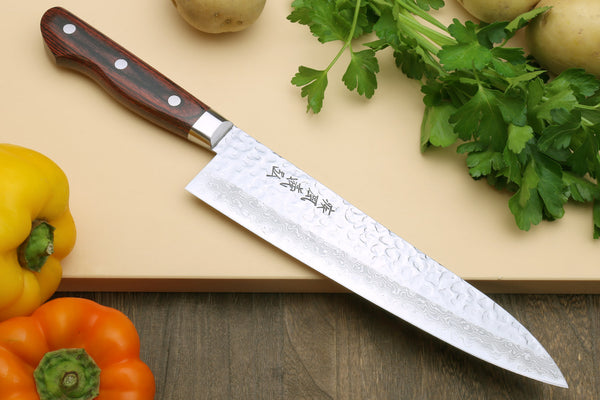 Yoshihiro VG-10 16 Layer Hammered Damascus Stainless Steel Gyuto Chefs KnifeFrom $144.99
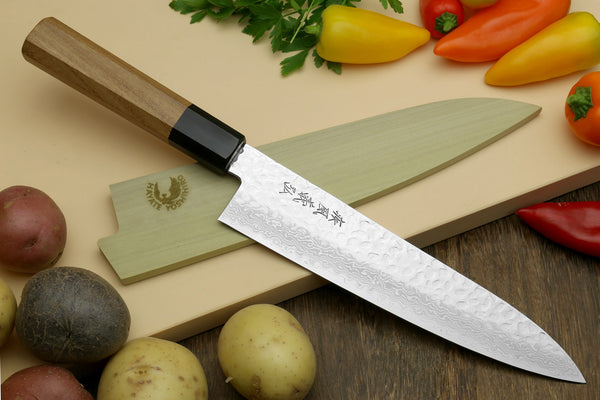 Yoshihiro VG-10 46 Layers Hammered Damascus Gyuto Japanese Chefs Knife (Octagonal Ambrosia Handle)From $174.99
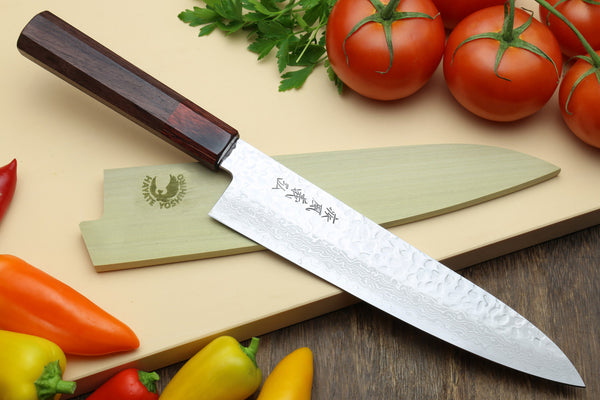 Yoshihiro VG-10 46 Layers Hammered Damascus Gyuto Japanese Chefs Knife (Octagonal Shitan Rosewood Handle)From $174.99
Not sure which shape? Use the knife finder
Handles
Japanese knives come with either a traditional Japanese handle or a Western one. Our handle guide compares the two.
- Wa-handle (和柄) — A traditional Japanese handle: light, with the tang fitted into it rather than riveted. Usually octagonal, oval or D-shaped.
- Yo-handle (洋柄) — A Western-style handle, usually full tang with rivets.
- Tsuka (柄) — The handle.
- Hakkaku (八角) — Octagonal; a popular wa-handle shape, comfortable for either hand.
- D-shape — A wa-handle with one flat side, made for either right- or left-handed use.
- Ferrule (口輪) — The collar where the handle meets the blade, often buffalo horn or pakka wood.
- Ho wood (朴) — Japanese magnolia. A light, traditional handle wood.
- Shitan (紫檀) — Rosewood. A dense, dark and durable handle wood.
- Kokutan (黒檀) — Ebony. Very dense, black and heavy.
Want a new handle on a knife you already own? See our knife handle service. Shopping for a new knife? Browse our knives; each listing shows its handle style.
Sharpening and Care
Japanese knives are sharpened on water stones, and a few simple habits keep them at their best. Start with our sharpening guide and care guide.
- Toishi (砥石) — A whetstone.
- Arato (荒砥) — A coarse stone, roughly 120–600 grit, for repairing chips and reshaping an edge.
- Nakato (中砥) — A medium stone, roughly 800–2000 grit, for regular sharpening.
- Shiageto (仕上げ砥) — A finishing stone, roughly 3000 grit and up, for refining and polishing the edge.
- Nagura (名倉) — A small stone rubbed on a finishing stone to raise a slurry that speeds up polishing.
- Splash-and-go — A whetstone that only needs a splash of water, rather than soaking, before use.
- Sabi (錆) — Rust.
- Patina — The gray-blue layer that forms on carbon steel with use. It's harmless and helps protect the steel from red rust.
- Sabitori (錆取り) — "Rust removal"; a rubber-abrasive block used to clean surface rust from a blade.
- Tsubaki oil (椿油) — Camellia oil, the traditional food-safe oil for protecting carbon steel from rust.
- Saya (鞘) — A wooden sheath that protects the blade, often held on with a small wooden pin.
Tsubaki oil and sabitori
View all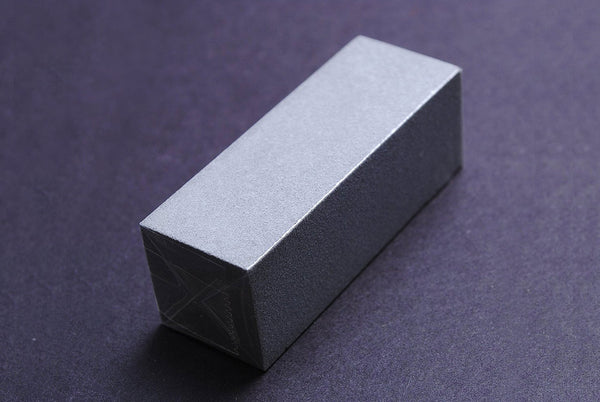
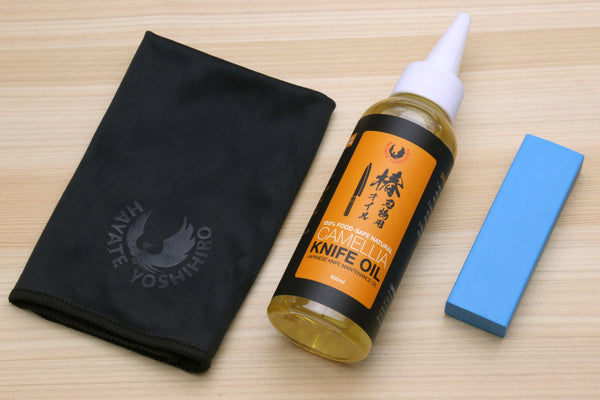
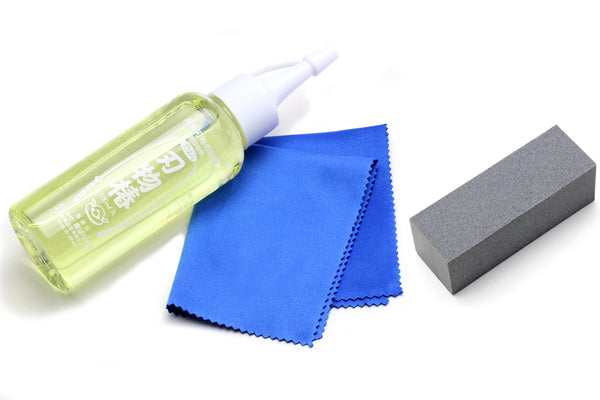
Shop the rest of the kit: whetstones and saya covers. Rather not sharpen it yourself? Try our sharpening service.
Cutting and Kitchen Terms
Words you'll come across in Japanese cooking and in descriptions of what a knife is for.
- Itamae (板前) — "In front of the board." A trained chef in a Japanese restaurant.
- Hikigiri (引き切り) — A pull cut, drawing the knife toward you in one long stroke. The way sashimi is sliced.
- Katsuramuki (桂剥き) — Peeling a vegetable such as daikon into one long, paper-thin sheet with an usuba.
- Sengiri (千切り) — Very fine julienne.
- Sashimi (刺身) — Sliced raw fish, served without rice.
- Kanto and Kansai (関東・関西) — The Tokyo and Osaka regions. Many knife shapes come in a Kanto (square-tipped) and Kansai (pointed or rounded) version.
Still Have a Question?
If a term you're looking for isn't here, or you'd like help choosing a knife, get in touch and we'll be glad to help. You're welcome to link to this glossary from your own site or forum posts.


